The Paradigm of European Strategic Autonomy in 2026
In a landscape of unprecedented international uncertainty, the business world is facing a geopolitical chessboard that defies every known rule.
In a landscape of unprecedented international uncertainty, the business world is facing a geopolitical chessboard that defies every known rule. At Thinking Heads, we recently had the opportunity to host an exclusive session with Josep Borrell, former High Representative of the European Union for Foreign Affairs and Security Policy, alongside prominent executives from various sectors to analyze the forces reshaping our environment.
The diagnosis was clear: in this new world order defined by coercion, technological dependency, and geopolitical fragmentation, European strategic autonomy remains a top priority for any organization operating within this new paradigm.
This article outlines the most critical takeaways from that dialogue–conclusions with direct implications for the agendas of those managing communication, institutional relations, and corporate affairs.
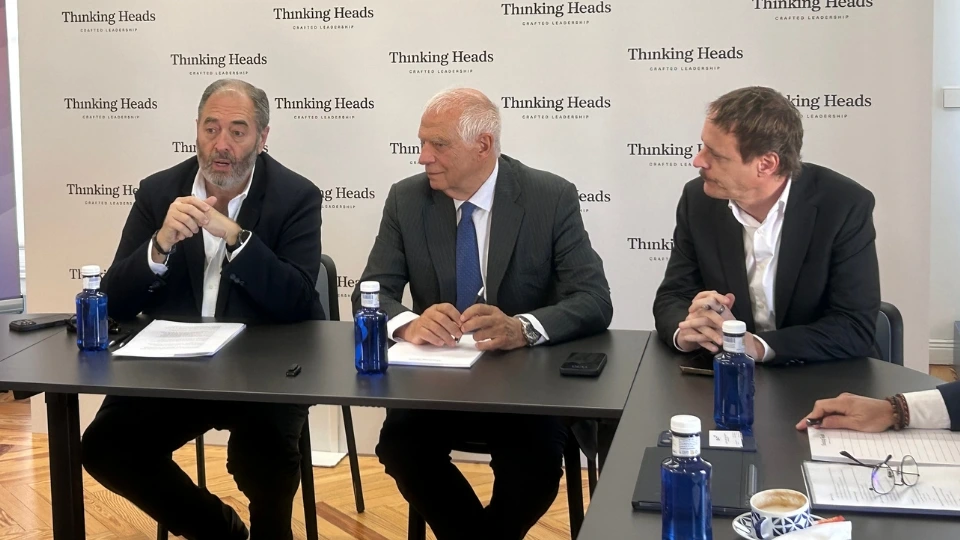
From left to right: Antonio Hernández-Rodicio, Partner at Thinking Heads; Josep Borrell, former High Representative of the European Union for Foreign Affairs and Security Policy; and Iván Abanades, Partner at Thinking Heads.
The Decline of Traditional Values and the Rise of the “Dark Enlightenment”
The new world order is undergoing a profound shift away from the values established since the French Revolution, such as democracy, human rights, and judicial independence. Borrell warns of the rise of the “Dark Enlightenment“, an ideological movement championed by American tech magnates like Peter Thiel, who view the liberal democratic order as obsolete.
This doctrinal framework—discussed in niche intellectual circles—advocates for a world organized around centralized leadership with absolute power, operating under the logic and lens of a private corporation.
In this context, Borrell pointed to Trumpism as a clear manifestation of this trend. The Trump phenomenon is not a random glitch in the American democratic system; it is the most visible sign of an organized ideological current with a long-term agenda. Understanding it as such completely changes how an organization must plan its engagement with the geopolitical environment.
Europe’s Strategic Dependency: Deeper Than We Think
The European Union was not conceived to fight or compete in a world of geopolitical confrontation. It is fundamentally a project of peace and cooperation, not an entity designed for conflict.
In the face of this global juncture, the quest for European strategic autonomy—a major stated goal of EU foreign policy in recent years—hits a structural wall that Borrell breaks down with precision:
Technology and Digital Infrastructure: 100% of the relevant cloud computing for European companies and institutions is in the hands of U.S. providers. If the U.S. decided to cut off access, Europe would be, in Borrell’s words, “completely left out to dry”.
Connectivity and the Payments Ecosystem: Most subsea fiber optic cables are American-owned or controlled. International payment clearing systems operate under U.S. jurisdiction, turning U.S. sanctions into global instruments that Europe cannot replicate.
Institutional Gridlock: The unanimity rule in the European Council allows countries with agendas aligned with Russia or China—noting that 40% of Chinese investment in Europe is concentrated in Hungary—to effectively act as “veto players” against any collective response.
Lack of Fiscal Capacity: Europe is not a fiscal power; it does not collect its own taxes and cannot increase spending autonomously. Everything it distributes must first be contributed by Member States. Read more in our blog post: Europe and Banking in Playtime.
Economic Disruptors in Europe: Tariffs, AI, the Climate Agenda, and Deregulation
The new world order translates directly into four economic factors impacting corporate strategy:
An Unpredictable Tariff War: Tariff volatility is no longer a manageable variable. The American tariff system now operates through the logic of political coercion rather than trade policy: it changes overnight, is declared illegal by U.S. courts, and is then reinstated by executive decree. Borrell puts it bluntly: “No one has any visibility anymore on the transfer price of a product to the American economy”.
A Potential AI Bubble: Borrell diagnoses AI as both a real structural shift—one billion generative AI users in just a few years, growing ten times faster than previous tech revolutions—and a massive accumulation of speculative capital without matching real-world returns. “Nvidia’s value is higher than India’s GDP. There is no rate of return that justifies those valuations”.
Backtracking on the Climate Agenda: The American abandonment of the climate agenda has implications far beyond the environment. With widespread skepticism in the U.S.—responsible for 25% of global emissions—the European regulatory argument loses its leverage over the rest of the world. As Europe represents only 6% of global emissions, the effort to reduce that percentage becomes politically unsustainable if the world’s largest historical emitter has left the framework. The European regulatory pendulum has already begun to swing: a moratorium on ending internal combustion engines, the practical suspension of the deforestation directive, and “omnibus” laws dismantling regulations passed just two years ago.
Deregulation and Competitiveness: Following years of regulatory expansion, Brussels is now pushing for simplification. This is what Borrell calls the “regulatory see-saw”. In response to corporate complaints regarding regulatory overreach, we are seeing a strong trend toward deregulation to regain competitiveness. Consequently, the European Parliament is fast-tracking “omnibus” laws to repeal and reverse excess corporate mandates.
In this new world order, the ideological, technological, and economic forces that have built this new paradigm still have a long road ahead. Organizations that incorporate this reading into their strategy will have a perceptual advantage over those still waiting for a “return to normalcy” that is unlikely to arrive.
Europe must prepare to operate in a world dominated by unpredictable leadership. In this context, it must urgently decide if it is willing to pay the price for its own sovereignty. For businesses, this means redefining the public affairs agenda: anticipating geopolitical risks, diversifying critical dependencies, participating in the debate on European competitiveness, and understanding that corporate strategy can no longer be decoupled from the international context.
Utilizamos cookies para mejorar tu experiencia en nuestro sitio web.Al usar nuestra web, aceptas el uso de cookies.
Esta web usa cookies
Los sitios web almacenan cookies para mejorar la funcionalidad y personalizar tu experiencia. Puedes configurar tus preferencias, pero bloquear algunas cookies puede afectar el rendimiento y los servicios del sitio.
Essential cookies enable basic functions and are necessary for the proper function of the website.
Nombre
Descripción
Duración
Geolocation Config
This cookie is used to store the consent settings based on the visitor's location.
30 days
Cookie Preferences
This cookie is used to store the user's cookie consent preferences.
30 days
Google reCAPTCHA helps protect websites from spam and abuse by verifying user interactions through challenges.
Nombre
Descripción
Duración
_GRECAPTCHA
Google reCAPTCHA sets a necessary cookie (_GRECAPTCHA) when executed for the purpose of providing its risk analysis.
179 days
Google Tag Manager simplifies the management of marketing tags on your website without code changes.
Contains information related to marketing campaigns of the user. These are shared with Google AdWords / Google Ads when the Google Ads and Google Analytics accounts are linked together.
90 days
__utma
ID used to identify users and sessions
2 years after last activity
__utmt
Used to monitor number of Google Analytics server requests
10 minutes
__utmb
Used to distinguish new sessions and visits. This cookie is set when the GA.js javascript library is loaded and there is no existing __utmb cookie. The cookie is updated every time data is sent to the Google Analytics server.
30 minutes after last activity
__utmc
Used only with old Urchin versions of Google Analytics and not with GA.js. Was used to distinguish between new sessions and visits at the end of a session.
End of session (browser)
__utmz
Contains information about the traffic source or campaign that directed user to the website. The cookie is set when the GA.js javascript is loaded and updated when data is sent to the Google Anaytics server
6 months after last activity
__utmv
Contains custom information set by the web developer via the _setCustomVar method in Google Analytics. This cookie is updated every time new data is sent to the Google Analytics server.
2 years after last activity
__utmx
Used to determine whether a user is included in an A / B or Multivariate test.
18 months
_ga
ID used to identify users
2 years
_gali
Used by Google Analytics to determine which links on a page are being clicked
30 seconds
_ga_
ID used to identify users
2 years
_gid
ID used to identify users for 24 hours after last activity
24 hours
_gat
Used to monitor number of Google Analytics server requests when using Google Tag Manager