The European Union is the answer to the major challenges we face as a society. It was 40 years ago, when Spain joined the European Economic Community; 15 years ago, during the financial crisis that hit Spain severely; and again 5 years ago, during the COVID-19 pandemic, when €750 billion were mobilized in direct transfers and loans to support recovery.
The history of 21st-century Spain cannot be understood without the European Union. The EU’s institutional mechanisms have enabled economic and social progress that would have been difficult to achieve on our own. This is not a criticism of our country, but rather a reflection of Europe’s strength: we are stronger when we move forward together toward shared solutions to collective challenges.
The 40th anniversary of Spain’s membership in the European Union, celebrated this June, invites us to reflect on its past and present, on Europe’s key role in our nation’s socioeconomic development, and on the challenges ahead. As nations, as a continent, and as a global power, this context compels us to reaffirm two principles we should never have forgotten: the balance between the necessary strategic autonomy and the indispensable competitiveness required in a globalized world.
The return of war to Europe, the foreign policies of traditional global powers, and increasing geopolitical uncertainty have forced Brussels to look in the mirror—to stop applying temporary fixes and start implementing real solutions. This means strengthening our internal market to avoid depending on imports in areas where Europe has always been strong: long-standing industrial sectors and a resilient, responsive financial system.
Because if we want to build “more Europe,” we must rely on the mechanisms that can make this progress possible. The banking sector is called to play a leading role in the global transition currently underway, in digitalization, sustainability, security and defense, and competitiveness. Achieving this demands a regulatory framework that advances precisely in competitiveness, across all productive sectors, and especially in banking, which is responsible for 70% of corporate financing in Europe.
This regulatory simplification, in favor of the European Union’s competitiveness, was one of the key takeaways from the event “Strengths of the Spanish Banking Sector in Times of Global Transition,” organized in Frankfurt by Spain’s two main banking associations, AEB and CECA, to showcase the strength of the Spanish banking industry in a context of global transition.
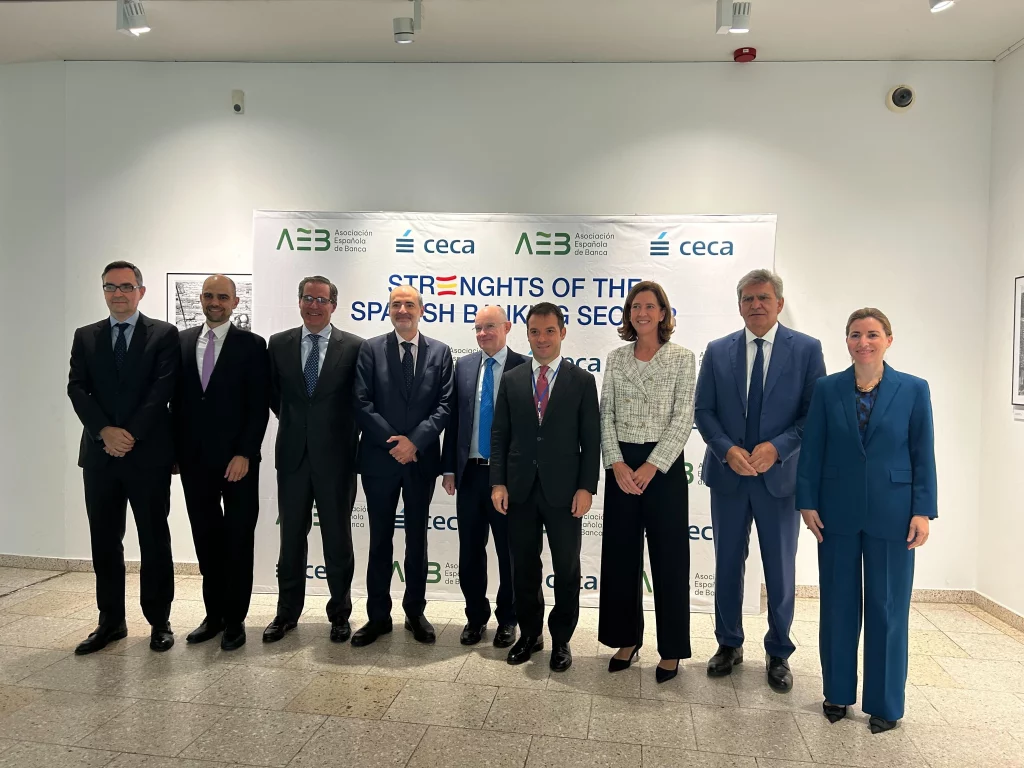
From the financial capital of the EU, representatives from the associations, the European Central Bank, and leading institutions of our country, such as Banco Santander, BBVA, and CaixaBank, agreed that the best response to the European Union’s challenges is a Europe that fosters competitiveness, with legislation that does not hinder financing or the continent’s collective growth.
Robert Schuman, one of the founding fathers of the European Union, once said that Europe will not be made all at once, nor as a single construction, but through concrete achievements. In today’s political context—marked by the rise of populism across the West, particularly in the continent’s major countries—it is in our hands to bring about those concrete achievements that continue to improve our quality of life.
The success of the European Union lies in its history as a process of progress and accumulation—a continuous building effort. That is why our present and our future mean more Europe: to keep advancing the welfare state and extend its fifth pillar, housing; to continue providing joint responses to challenges that no longer affect only a few; and to ensure that protection mechanisms reach the broadest segments of society. In short, more Europe in the face of those who seek to divide it.