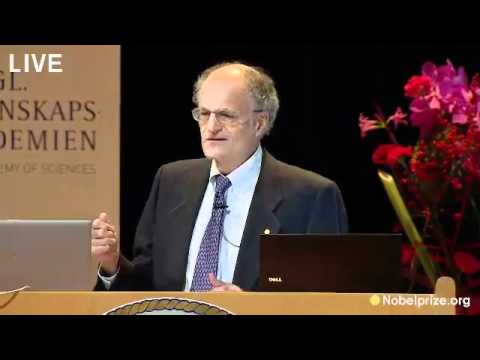
Thomas J. Sargent is a renowned American economist and expert in macroeconomics, monetary economics, and econometrics. Known for his pioneering work in rational expectations theory, Sargent is a key figure in modern economic research. In 2011, he was awarded the Nobel Prize in Economics, shared with Christopher A. Sims, for his empirical research on causality in macroeconomics. He currently serves as the W.R. Berkley Professor of Economics and Business at New York University, holding a joint appointment with the Economics Department and the Stern School of Business.
Thomas J. Sargent’s academic career spans several prestigious institutions. After earning his B.A. from the University of California, Berkeley, and his Ph.D. from Harvard University, he taught at numerous universities, including the University of Minnesota, the University of Chicago, and Stanford. Sargent has been a member of the Econometric Society since 1976, and in 1983 he was elected as a fellow of both the American Academy of Arts and Sciences and the National Academy of Sciences. Widely cited and highly influential, his research has been foundational to the development of modern macroeconomic models.
Thomas J. Sargent’s conferences are characterized by their rigor and depth, addressing complex topics in macroeconomics and econometrics in an accessible and clear manner. His talks delve into causality in economics, rational expectations, and their applications in monetary and fiscal policy, providing attendees with advanced insights into these core concepts. With both academic and practical focus, Sargent presents the implications of his research on the current and future economy, attracting economists, academics, and financial sector professionals interested in macroeconomic analysis.
Thomas J. Sargent explores the concept of rational expectations and its influence on monetary policy. In this talk, he examines how economic agents’ decisions, based on future expectations, affect the effectiveness of government policies and economic models.
In this conference, Sargent discusses his research on causality in macroeconomics and the methods used to study the impact of various economic policies. He presents case studies and examines the challenges that arise in determining cause-and-effect relationships in macroeconomics.
Drawing on his work in Recursive Macroeconomic Theory, Sargent provides an introduction to recursive macroeconomic theory and its application in economic modeling. He explains how this methodology aids in better understanding economic fluctuations and the dynamics of long-term policy.
If you’re looking for a high-level talk on macroeconomics, monetary policy, or rational expectations theory, you can book Thomas J. Sargent through Thinking Heads. As one of the most influential economists and a Nobel laureate, Thomas provides expert and profound insights into current macroeconomic topics. Contact Thinking Heads today for more information and to secure his participation in your next event.
View profile
Book Speaker
View profile
Book Speaker
View profile
Book Speaker
Contact us
Utilizamos cookies para mejorar tu experiencia en nuestro sitio web. Al usar nuestra web, aceptas el uso de cookies.
Los sitios web almacenan cookies para mejorar la funcionalidad y personalizar tu experiencia. Puedes configurar tus preferencias, pero bloquear algunas cookies puede afectar el rendimiento y los servicios del sitio.
Essential cookies enable basic functions and are necessary for the proper function of the website.
Google reCAPTCHA helps protect websites from spam and abuse by verifying user interactions through challenges.
Google Tag Manager simplifies the management of marketing tags on your website without code changes.
Service URL: thinkingheads.com (opens in a new window)
Statistics cookies collect information anonymously. This information helps us understand how visitors use our website.
Google Analytics is a powerful tool that tracks and analyzes website traffic for informed marketing decisions.
Service URL: policies.google.com (opens in a new window)
Puede encontrar más información en nuestra Cookies policy y en nuestra How we treat your data.